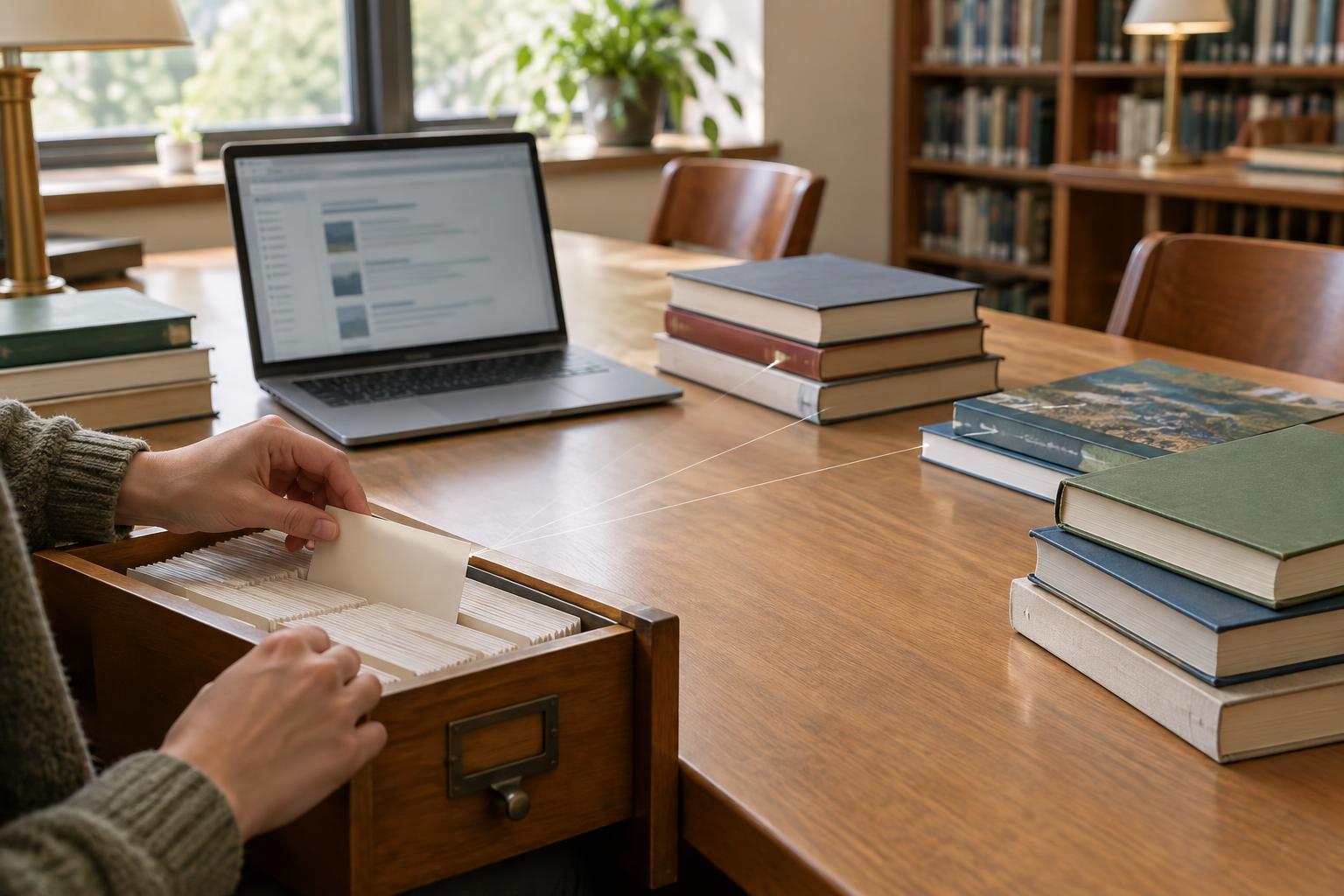
Start by separating facts from guesses
A partial citation may contain an author’s surname, a few words of a title, a year, or a journal abbreviation. Before searching, copy it exactly as it appears. Then mark which details are clear and which might be wrong. A year copied from a footnote may be a publication year, but it could also be the year of an edition or a web page update. Keeping that uncertainty visible prevents one shaky detail from ruling out the right source.
Make a short list of searchable clues: names, distinctive title words, subject terms, publication name, volume or issue number, page range, and identifiers such as a DOI or ISBN. Prioritize unusual combinations over broad terms. A surname plus a distinctive phrase is usually more useful than a surname plus a broad subject such as “education.” If the citation came from another work, note where you found it; the surrounding sentence may explain what the missing source was about.
Search from precise clues to broader ones
Begin with the most distinctive text you trust. Put an exact title fragment in quotation marks when using a search engine or scholarly search tool, and pair it with an author name if you have one. If that returns nothing, remove the quotation marks, shorten the phrase, or try alternative spellings and word forms. For instance, a reference to “workplace learning” might appear in a title that uses “learning at work.”
Search more than one type of resource. A library catalog can help identify books and editions; a scholarly index can help with journal articles and conference papers; a publisher’s site can help confirm publication details. If you know the publication name but not the article title, search within that journal or its archive by year, volume, or author. An identifier, when available, can be an especially direct route to a record, but check that the record matches the other clues.
Change one part of the search at a time. If every new query changes the author, year, and title words together, it becomes hard to tell which adjustment helped. Keep a brief note of promising queries and results so you do not repeat the same search or mistake a familiar-looking result for a verified match.
Expect errors in the citation itself
Incomplete references are not always accurate references. Names may be misspelled, initials may be missing, and a journal title may be abbreviated inconsistently. An article can also be cited under a translated title, a working-paper title, or a title that changed before final publication. If an exact search fails, try the author’s surname without initials, search a distinctive title word with the subject, or look for the cited work in the author’s publication list.
The type of source may be uncertain too. A phrase presented as a book title could be a chapter title; a conference paper might later appear as a journal article. Look at the structure of the surviving reference. Page numbers alongside a journal name suggest an article, while a city and publisher may point toward a book, though citation styles vary. Treat these as clues rather than proof.
Verify the match before using it
A result is a candidate, not a confirmation. Compare several independent details: author names, full title, publication venue, year, volume, issue, pages, and identifier where applicable. If one detail disagrees, investigate instead of silently correcting the original citation. Two authors with the same surname may publish on the same subject, and similarly titled pieces may be different versions of a work.
When possible, inspect the source itself, not just a search-result snippet. The first page of an article, a book’s title page, or a publisher’s record can clarify details that an automatically generated citation gets wrong. Also check whether the source supports the point for which it was cited. Finding a plausible bibliographic match does not establish that it contains the claimed argument or evidence.
Know when to stop and what to record
If you can identify a source but cannot access its full text, check your library’s holdings, request help from a librarian, or look for an openly available version provided by the author or institution. Avoid treating an abstract or a secondhand summary as though you have read the complete work. If several candidates remain, record the differences and the search terms you tried. That makes it easier to resume the search or ask someone else for help.
Sometimes a fragment is too vague to resolve reliably. In that case, leave the reference unverified rather than choosing the closest-looking result. A useful research note states what was supplied, which details were confirmed, and what remains uncertain. The aim is not simply to fill a blank in a bibliography; it is to connect a claim to the correct, inspectable source.