Start with the exact claim
Before opening the study, write down what the claim says in one sentence. Identify the outcome, the group it concerns and the strength of its wording. “A short walk improves memory in adults” is a different claim from “People who walked more often performed better on one memory task.” The first suggests that walking caused a broad improvement; the second describes a narrower finding.
Notice words such as “proves,” “causes,” “prevents,” “everyone” and “always.” They may be stronger than the evidence allows. Also look for details the claim leaves out: How much walking? What kind of memory task? Compared with what? These questions give you specific points to check, rather than a vague impression that the claim sounds plausible.
Find the study, not just another summary
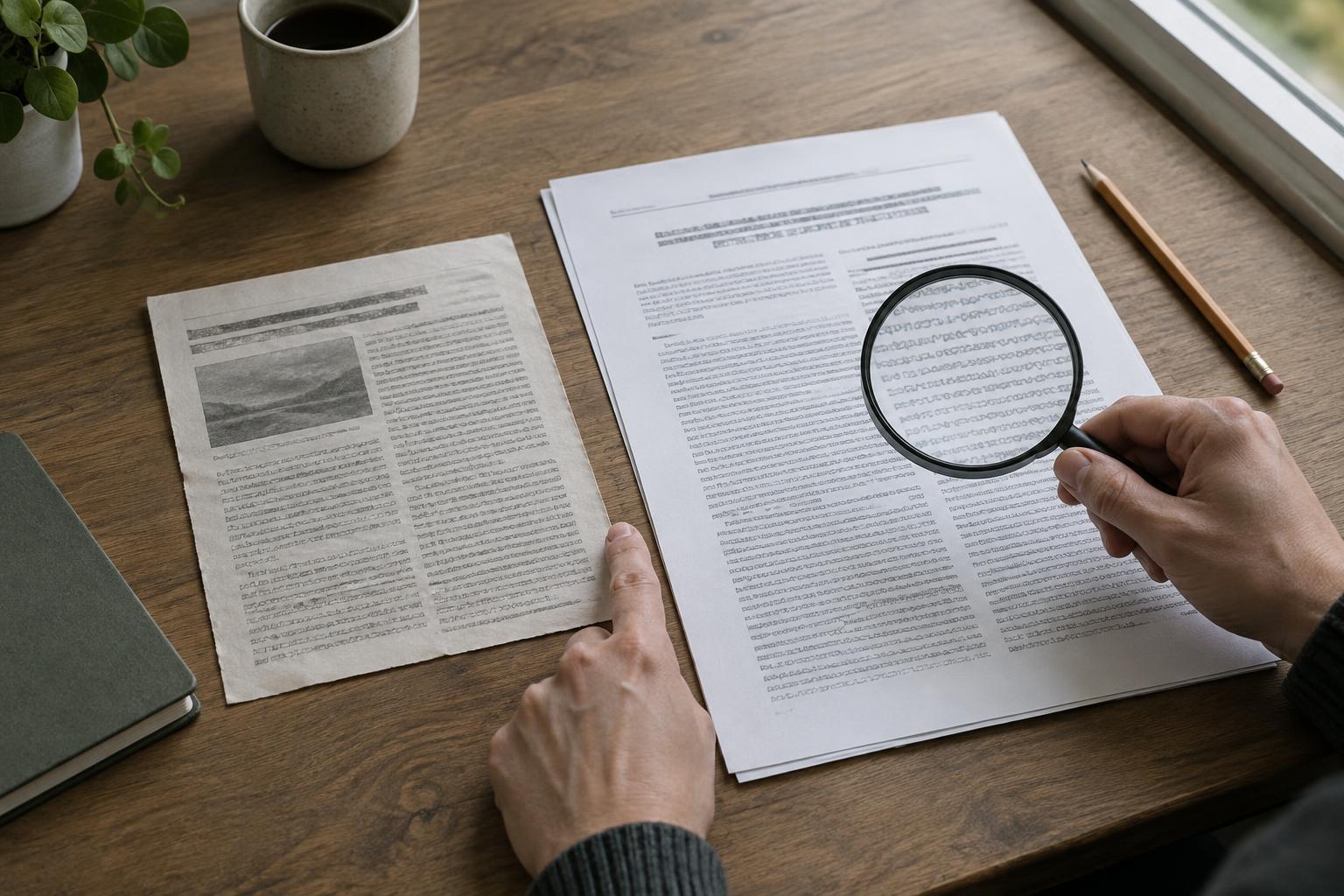
Follow the claim back to the original study when possible. A news story, social post or press release may link to it or name its authors and title. Check that you have the study being discussed, not a related paper on the same subject. If the full text is unavailable, an abstract can help you begin, but it may not contain enough detail to settle every question.
Once you have the paper, start with its research question and methods. Ask who or what was studied, how participants or observations were selected, what was measured and what the comparison was. In a hypothetical walking study, a result from one memory exercise completed by a small group of volunteers would not automatically establish an effect on everyday memory for all adults. The distance between the people and measures in the study and those named in the claim matters.
Match the claim’s certainty to the study design
Study design helps determine what a result can show. If researchers observe that people who walk more also score higher on a memory test, they have found an association. Other differences between the groups could help explain it. A study that assigns participants to different activities can offer stronger evidence about the effect of that particular activity, although its results still depend on how the study was conducted and what it measured.
Read the results for the actual comparison. Did performance change within one group, or was it better than in a comparison group? A before-and-after improvement alone might not show that the activity produced the change. Check whether the reported result concerns the main question or one of many additional measures. A claim about “memory” may rest on a single test score while other measured outcomes showed little difference.
Check the size and meaning of the result
A claim can be technically connected to a result yet exaggerate its importance. Look for the number of participants or observations, the size of the difference and any range of uncertainty the authors report. A result described as statistically significant is not necessarily large or useful in practice. Conversely, an uncertain estimate does not by itself show that no effect exists; it may mean the study cannot distinguish clearly among several possibilities.
Pay attention to the units and denominator. “Scores rose by 10 percent” could mean a relative change, while “scores rose by 10 points” describes a different quantity. Ask what the score measures and whether the difference would be noticeable outside the test. If a summary gives a dramatic percentage but no starting level, look for the underlying numbers before drawing a conclusion.
Write a narrower, more faithful takeaway
Finally, compare the headline with the authors’ discussion and stated limitations. The discussion can clarify why the finding matters, but it may also propose explanations that the study did not directly test. Keep measured results separate from those proposals. Check whether the study’s setting, participants or follow-up period limits how widely its findings might apply.
A useful takeaway names the population, comparison and outcome without claiming more certainty than the methods support. For the hypothetical example, that might be: “In this study, participants assigned to a short walk scored higher on a specific memory task than participants assigned to a seated activity.” Add important qualifications if the sample was narrow or the result uncertain. The goal is not to dismiss every simplified claim; it is to preserve the conditions under which the evidence was gathered. If you cannot access enough of the study to check those conditions, say what remains unknown rather than treating the summary as proof.