
Presenting FindingsResearch results do not always tell a tidy story. Learn how to show where findings agree, where they differ, and what readers can reasonably take from the full set.
Read article · 3 min↗
Presenting FindingsA clear research report helps readers understand the question, follow the evidence and see what the findings do—and do not—support. Use this revision process to improve structure, trim unnecessary wording and keep important qualifications intact.
Read article · 4 min↗

Presenting FindingsA finding describes what the evidence shows; a recommendation proposes what to do. Learn how to keep the two distinct while making the reasoning between them clear.
Read article · 4 min↗

Presenting FindingsClear citations help readers see where a finding came from, check the original context and distinguish your interpretation from someone else’s work. Learn where to place citations, what details to include and how to make sources easy to follow in reports and presentations.
Read article · 4 min↗

Presenting FindingsA short research briefing is not a compressed report. Learn how to identify the main message, choose the evidence your audience needs, explain uncertainty, and close with a useful next step.
Read article · 5 min↗

Presenting FindingsA useful research slide deck does more than summarize a report. It guides an audience from the question and approach to the evidence, interpretation and limits. Learn how to choose a clear message, organize slides, simplify visuals and prepare to explain your findings aloud.
Read article · 4 min↗
Presenting FindingsA quotation can make a qualitative finding vivid, but it cannot carry the analysis on its own. Learn how to choose excerpts that support a clear claim, preserve context, represent variation, and protect participants.
Read article · 4 min↗

Presenting FindingsA useful chart description tells readers what was measured, what pattern is visible and where the limits of that pattern lie. Learn how to turn a visual display into clear prose without overstating the evidence.
Read article · 4 min↗

Presenting FindingsA chart should help readers see the result, not make them work to decode it. Learn how to avoid misleading scales, unsuitable chart types, crowded layouts, missing context and labels that leave research findings open to misinterpretation.
Read article · 4 min↗

Presenting FindingsA reader should be able to understand a figure without searching the surrounding text for its subject, measures, or limitations. Learn what belongs in a figure title, caption, and note, with a practical example and a checklist for revision.
Read article · 4 min↗
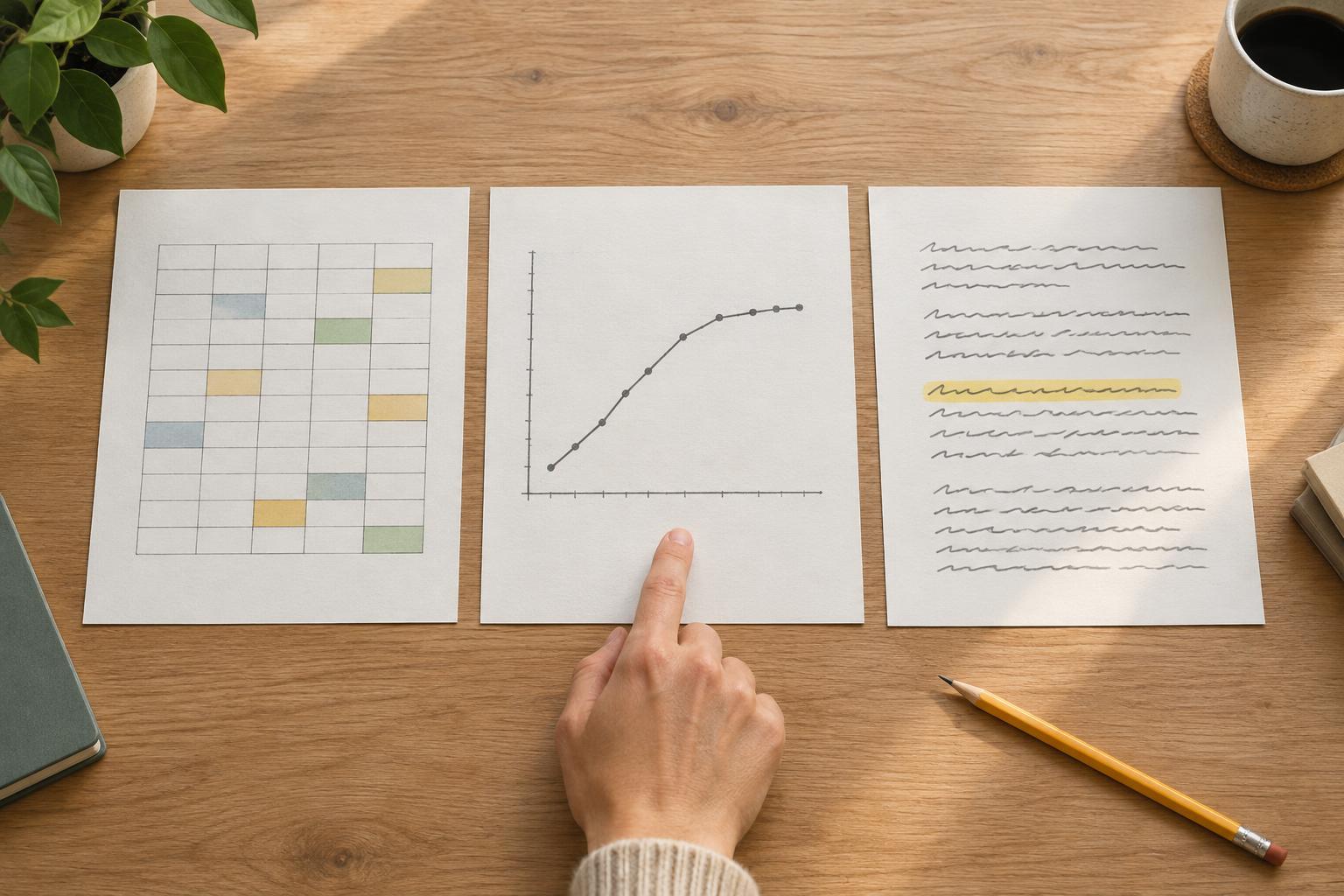
Presenting FindingsThe best format for a finding depends on what readers need to do with it. Use a table for exact values, a chart for patterns, and prose for meaning and context. Learn how to make the choice with practical examples.
Read article · 4 min↗
Presenting FindingsA clear conclusion does not hide uncertainty or bury it in a disclaimer. Learn how to state what your evidence supports, explain what remains unclear, and help readers understand why the limits matter.
Read article · 4 min↗

Presenting FindingsA clear results section tells readers what you found before explaining what it might mean. Learn how to separate observations from explanations, handle uncertainty, and guide readers from evidence to a measured conclusion.
Read article · 4 min↗

Presenting FindingsA clear methods explanation tells readers what you examined, how you chose it, what you did with it and where the approach has limits. Learn how to include those essentials without turning a presentation into a procedural manual.
Read article · 4 min↗

Presenting FindingsA source-by-source report can make readers do the work of finding the connections. Learn how to group evidence around the ideas that answer your research question, while still showing where each finding came from.
Read article · 4 min↗

Presenting FindingsAn executive summary helps a reader understand a decision without working through an entire report first. Learn how to frame the choice, select evidence, state a recommendation and make uncertainty visible.
Read article · 4 min↗

Presenting FindingsA useful study summary helps readers understand the question, the approach, the findings and the limits without needing specialist vocabulary. This guide offers a practical structure, a worked example and a revision checklist.
Read article · 4 min↗
Presenting FindingsThe same finding can serve different readers without changing its meaning. Learn how to adjust context, language, detail and format while preserving evidence, uncertainty and limitations.
Read article · 4 min↗

Presenting FindingsA clear presentation starts with the answer, not a tour of the work. Learn how to state your main finding early while making its scope, uncertainty and practical meaning clear.
Read article · 4 min↗
Presenting FindingsA useful abstract gives readers a compact, accurate account of a research project: its question, approach, main finding and significance. Learn how to draft one from the finished work, choose details that matter and avoid claims the evidence cannot support.
Read article · 4 min↗

Presenting FindingsA useful research report leads readers from a clear question through the evidence to a conclusion they can assess. Learn what belongs in each section, how to separate findings from interpretation, and how to keep the report focused on its purpose.
Read article · 4 min↗